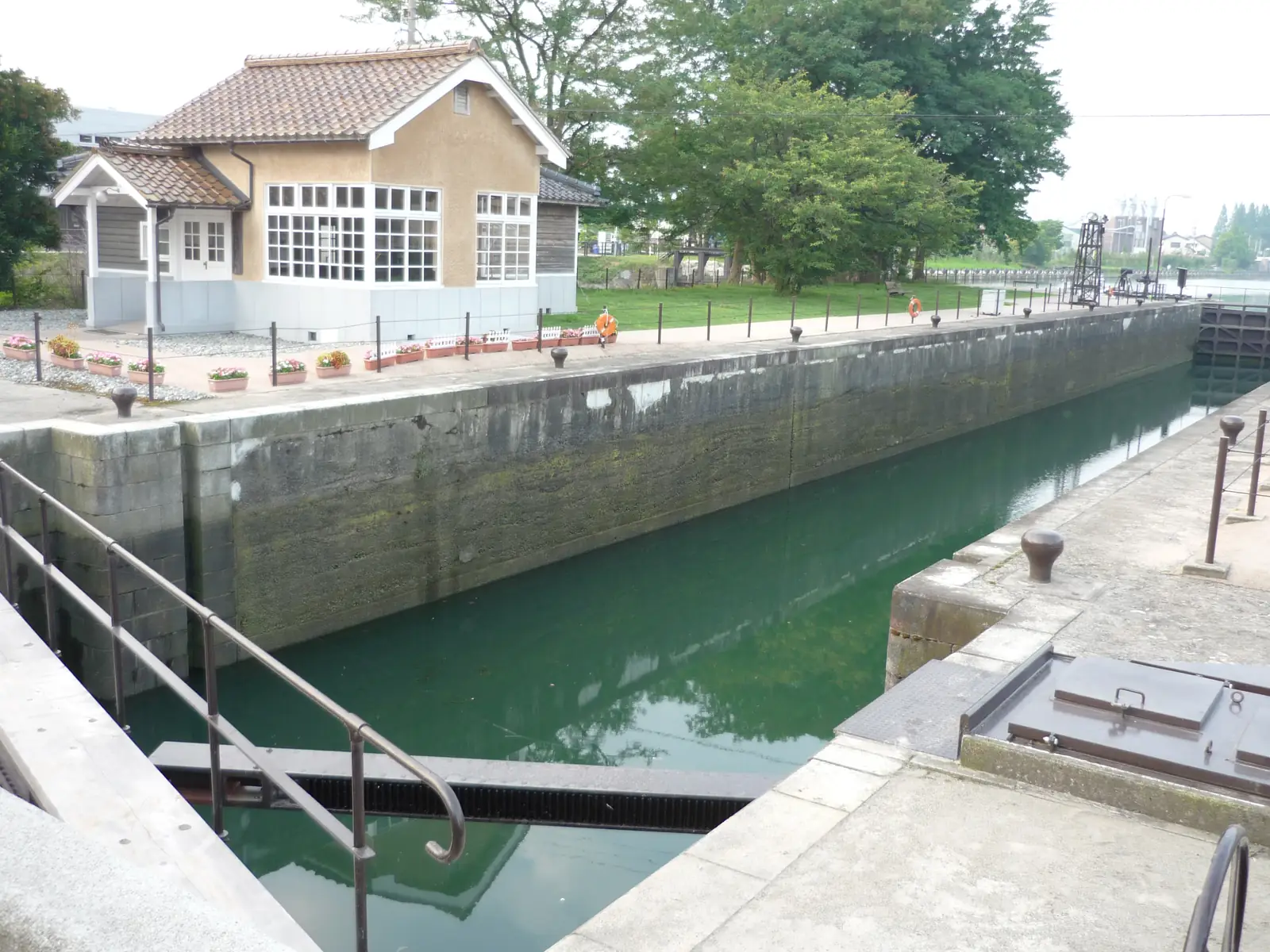
Why is there a canal north of Toyama Station? Step out of the north exit and a straight ribbon of water soon appears between the buildings: Fugan Canal Kansui Park, the starting point of the Fugan Suijo Line, a canal cruise that runs from here through the Nakajima Lock down to the old port town of Iwase. It looks like a waterway made for sightseeing, but it was not dug for pleasure boats. It began with a drastic piece of city planning — rerouting a river in its entirety.
What a rerouted river left behind
The Jinzu River once meandered broadly through the middle of Toyama. Straightening that meander was the Hasekoshi channel project, carried out from 1901 to 1903.
The river's departure left a wide stretch of abandoned riverbed across the city center. In 1928, a city plan was adopted that treated the reclaiming of that land and the digging of a canal as a single undertaking; work on the Fugan Canal began in 1930, and it was completed in 1935. The quiet water the boat glides over today is what the city that rerouted its river left behind.
A water elevator that lowers the whole boat 2.5 meters
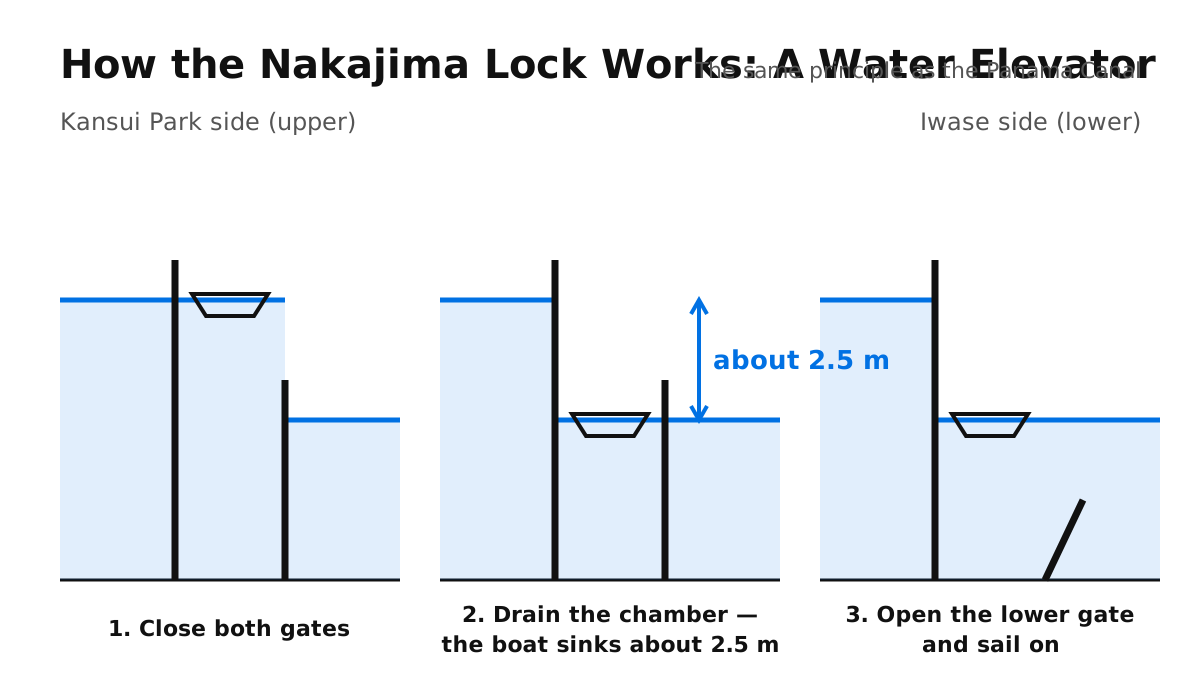
Midway along the cruise, the boat enters the Nakajima Lock, completed in 1934 and built on the same principle as the locks of the Panama Canal. The gates close ahead and astern, the chamber drains, and the boat sinks slowly, water level and all — a drop of about 2.5 meters. Standing on deck, you watch the quay wall that was just at eye level rise little by little into a wall above your head. Nothing is moving but the water, yet it feels like riding down through a building. "Water elevator," the nickname goes, and once you have ridden it, the metaphor turns out to be exact.
In 1998 the Nakajima Lock became the first civil engineering structure of Japan's Showa era to be designated a National Important Cultural Property. It is, so to speak, a cultural property in motion — still on active duty, adjusting the water level for the boats that ply this canal each year from spring to autumn.
The canal ends in a kitamaebune port town
Past the lock, the boat's final stop is Iwase, a port town that flourished on the kitamaebune — the merchant ships that once traded along the Sea of Japan coast. The route runs from Kansui Park through the Nakajima Lock to Iwase: it starts at an urban waterside, pauses for a breath at the lock, and ends among old streets by the sea. Kansui Park, the departure point, is a waterside park built around the canal's former boat basin, an easy walk from the north side of Toyama Station. To board a boat in a park of lawns and water and step off in a town built by cargo ships — that contrast is part of the cruise's flavor. What the canal connects is not just two places, but two eras: the city planning of the Showa years, and the shipping trade of Edo and Meiji.
To ride a city's memory up and down, water level and all — the Fugan Suijo Line follows the waterway a rerouted river left to its town, from the lowest vantage point there is.