In the Morning, No One Is in the Cloister Yet
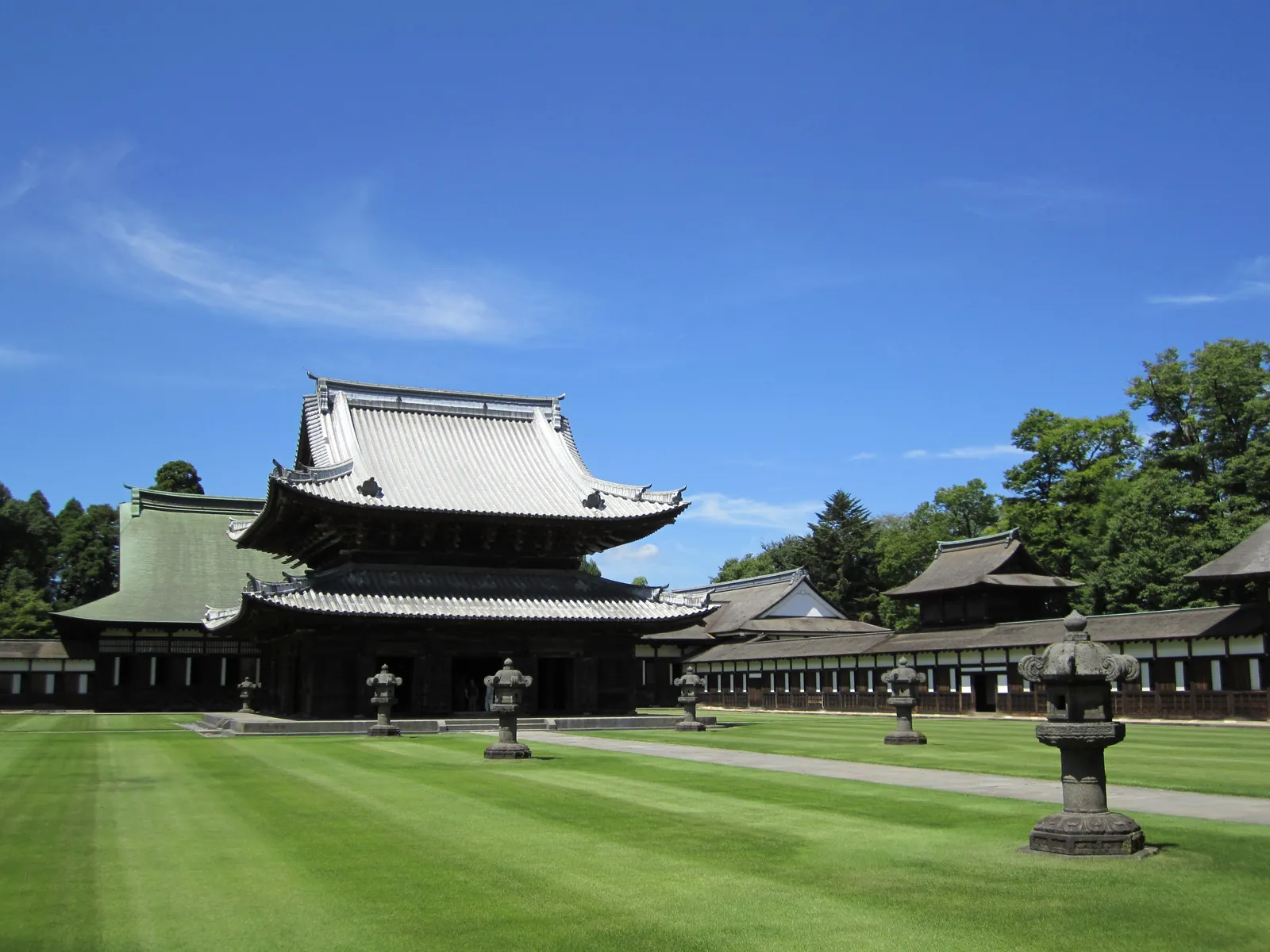
Just after the gates open, Zuiryuji Temple has a stretch of time with no one in sight. Pass through the outer gate, and beyond the green of the lawn stands the sanmon gate, and beyond that the Buddha hall. The cloister pillars drop their morning shadows at even intervals, and the only sound is your own footsteps on the gravel. You are in the middle of Takaoka, yet here the very quality of the sound is different.
What catches the eye first is the roof of the Buddha hall. It is not the color a tiled roof ought to be: a dull silver that dissolves into an overcast sky and returns the light softly on clear days. This roof is laid with tiles of lead. Exceedingly rare even among Japan's temple architecture, it is the one feature that could be called the face of this temple.
A Temple Complex for a Single Lord
Zuiryuji Temple is a Soto Zen temple founded to pray for the repose of Maeda Toshinaga, second head of the Maeda clan of Kaga. To honor the lord who opened the town of Takaoka, the Maeda family poured long years and enormous sums into this complex. Its three great buildings — the sanmon gate, the Buddha hall, and the Dharma hall — are designated National Treasures.
Why lead for the roof? One theory holds that in wartime it could be melted down for musket balls, but nothing is known for certain. What is clear is that the Maeda clan did not hesitate at the extraordinary choice of covering an entire roof in lead.
The Symmetry Turns Three-Dimensional as You Walk
Reading the temple grounds is not difficult. Enter through the outer gate, and at the moment you pass under the sanmon, your view is squeezed into a rectangle by massive pillars and beams. Beyond it the lawn opens wide, with the Buddha hall straight ahead. Stop here once, and you can see that the sanmon, the Buddha hall, and the Dharma hall stand in a single straight line on one axis. That axis, and the symmetrical cloister that encloses it — the skeleton of the place is just these two things.
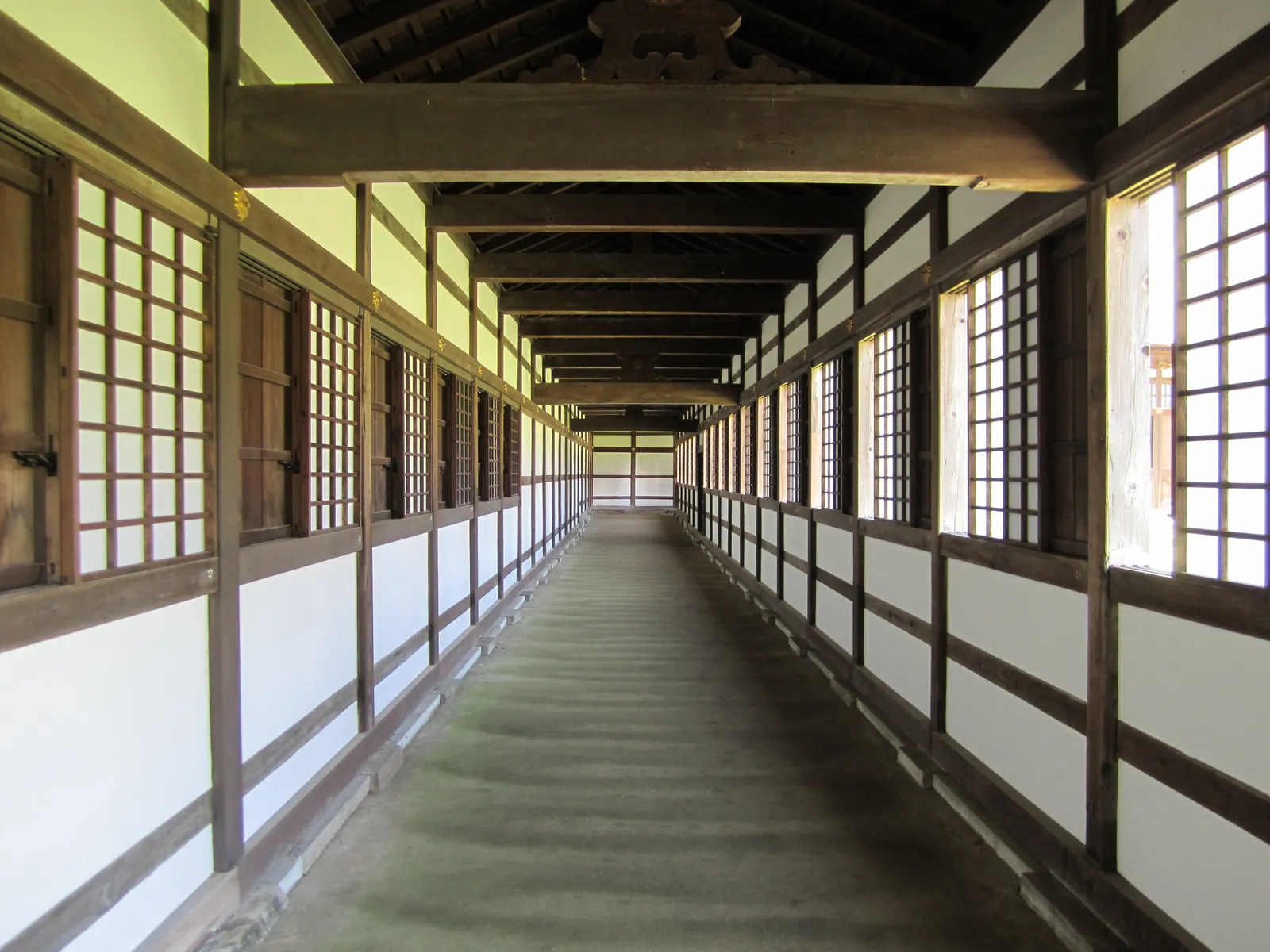
Next, step up into the cloister and walk a full circuit. As you begin to move, the evenly spaced pillars stream past, and the Buddha hall appears and disappears in the gaps between them. At every corner you turn, the axis that was just in front of you is seen from the side, then at last from behind. Reach the front of the Dharma hall and look back, and the symmetrical whole you have been walking finally settles into a single picture. A layout that looks flat in photographs becomes three-dimensional on foot.
The cloister is built so you can walk it dry in rain or snow, and the worse the weather, the more the lead roof sinks toward the color of the sky. The temple in sunshine and the temple in rain are almost two different works of architecture.
Better than midday, when the worshippers grow numerous, is the morning, when the shadows are long. This is a temple to walk in the hour when the lead roof begins its dull shine, taking in the silence along with everything else.